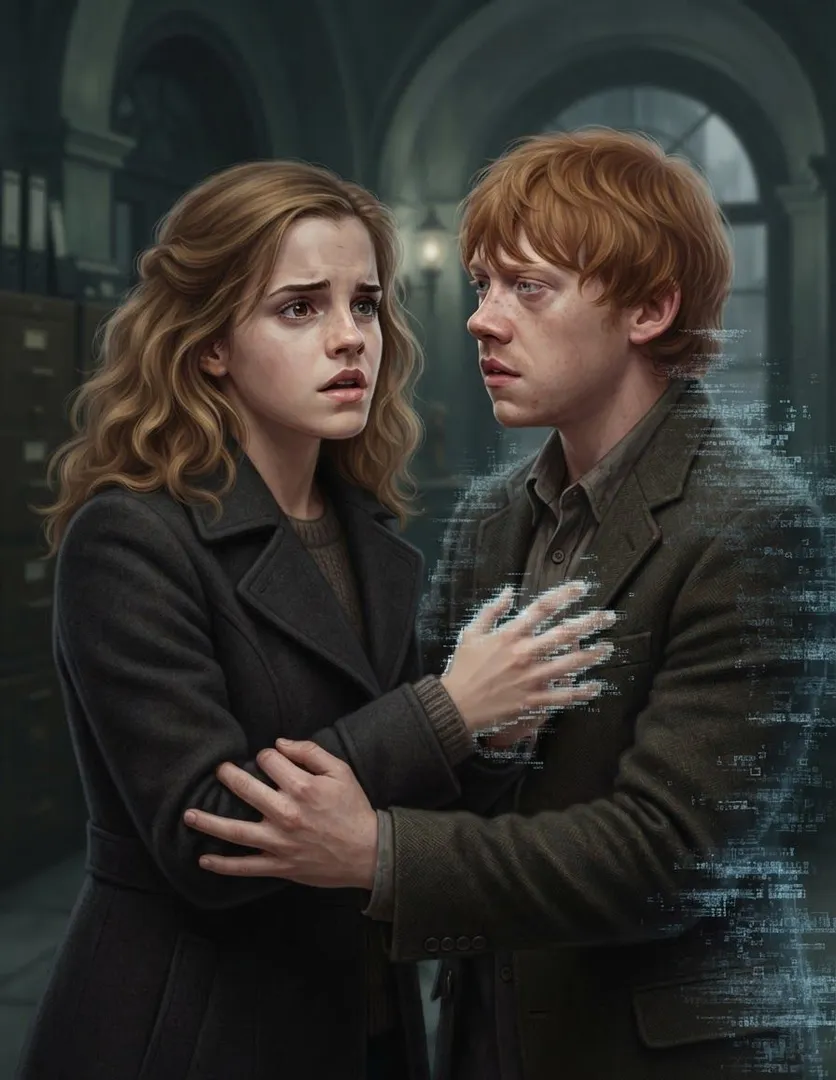
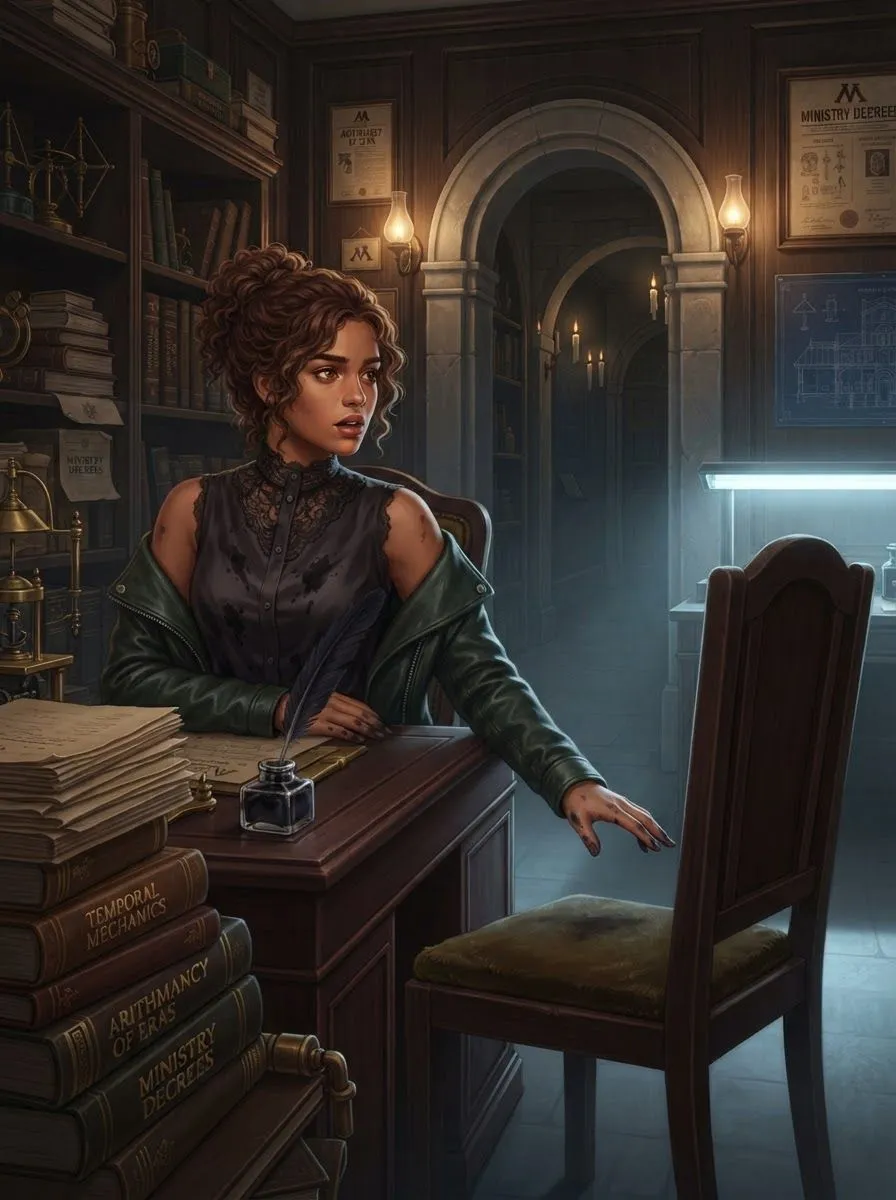
It begins without a sound. Barnaby Crouch, an Unspeakable in the Department of Mysteries, is discussing a classified file with Hermione Granger when his mouth stops mid-syllable. For a fraction of a second, his outline seems to hold, and then there is no one there — not a body, not a dust mote, not even the faint pop of Apparition. Hermione is left alone in a silent office, speaking to empty air, and when she runs to find help, no one in the Ministry remembers a Barnaby Crouch ever existed. His desk is gone. His name is not on any roster. His mother, when questioned, has never had a son.
This is the seventh disappearance. Hermione was the one who noticed the pattern because she keeps meticulous notes on personnel who vanish from departmental records without a transfer form — she had six names on a scroll she called 'the Memory Gap,' and every single Ministry official she showed it to accused her of writing nonsense. Now Barnaby has vanished in front of her, and she cannot prove it happened. Not to the Aurors. Not to Harry. Not to anyone.
But Harry believes her when she breaks down in his flat, clutching that crumpled scroll. Harry had a nightmare about Ron fading into white fog three nights ago and woke up screaming in a bed that suddenly contained only his own body. Something dark and ancient is un-weaving people from the fabric of existence itself, and it learned long ago that the Ministry cannot be trusted to fight what it cannot remember.
The trail of crumbs leads to a chamber beneath Hogwarts that the Marauders once dared each other to find — a vault sealed by the four founders themselves, containing a ritual called the Unwritten that was designed to remove a threat so completely that even cause and effect forgot it ever existed. The ritual was meant to erase the last of the Dementors' creators, a coven of soul-eaters who predated the Ministry and who learned to hide by erasing their own names from history. But the spell is not stable. It is spreading. And someone is feeding it.
As the erasures accelerate — an entire floor of the Ministry goes blank in a single afternoon — the trio must navigate a web of forgotten lore, treacherous alliances with old enemies, and the unbearable possibility that one of them already has a gap in their memory where a friend used to be. Hermione discovers that the Unwritten leaves a residue, a faint magical 'echo' only she can perceive because she has studied the fabric of memory so intimately. Harry discovers that his scar — now just a faint line — pulses when an erasure occurs nearby, as if the Horcrux connection left him tuned to the same frequency as death-unmaking. And Ron discovers something he cannot bring himself to say aloud: his sister Ginny vanished from his mental list of living people, and he had to check the family clock to confirm she still existed. The clock says she is alive, but the clock was made by his father. What if the Unwritten gets to the clock next?
The climax forces a choice that cannot be unmade: the only way to reverse the erasures is to anchor them back into reality using a living sacrifice of memory — a person willingly surrenders every personal recollection to become a fixed point that binds the erased to existence once more. Hermione volunteers, because she is the only one who could possibly rebuild herself from her own research notes. But as she stands on the ritual circle, Ron steps into the light instead. 'You're the one who holds all the pieces, Hermione. I'm the one who holds the people. You can't erase yourself, because then the pattern dies with you. I can be forgotten. I'd still be alive. I just wouldn't know who I am.' He is wrong. The ritual demands the sacrifice vanish entirely — not forget, but be forgotten, erased from all minds so that the erased can return. Ron is offering to die, in every way that matters, so a hundred strangers can live.
Hermione refuses. She rewrites the ritual at the last second, redirecting the cost to an object imbued with enough memory-weight to serve as the anchor — the final Horcrux diary, which she has kept hidden, preserving the echo of Tom Riddle's soul. The diary burns, and a hundred people flicker back into existence across the country, gasping, bewildered, remembered. But Tom Riddle's consciousness, caught mid-erasure, is not fully gone. A sliver of him survives in the void between memories, waiting, patient, hungry. The final line of the story is Hermione discovering writing on a fresh page of a new diary that appeared in her bag. The ink moves in a familiar elegant hand: 'Clever girl. You should have let the redhead burn.'
There is no romance in this story. The trust that frays is the trust between the three friends and the trust in their own minds. The threat is existential and the ending is unsettling open — the enemy is not destroyed, only contained, and he can still write.
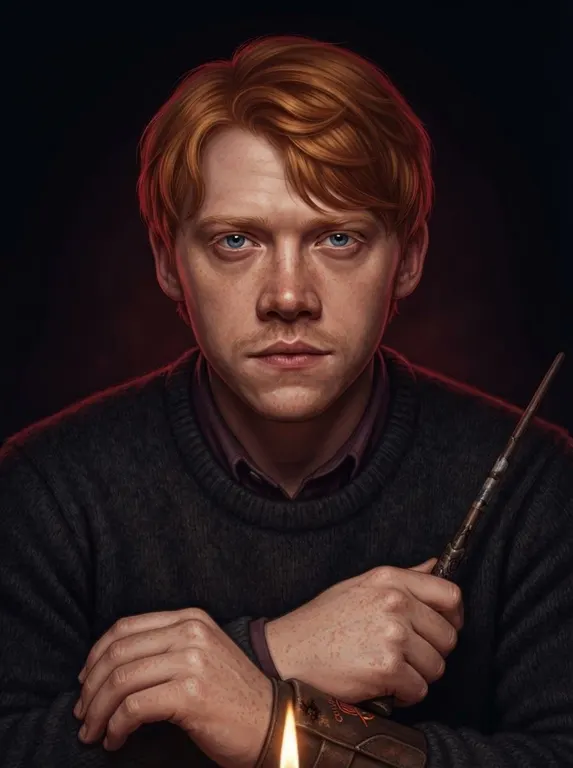
Harry's best friend, sixth of seven red-headed Weasleys, now an Auror learning he was always braver than he believed. Warm, funny, quick to jealousy and quicker to forgive, forever stepping out of taller shadows into his own.
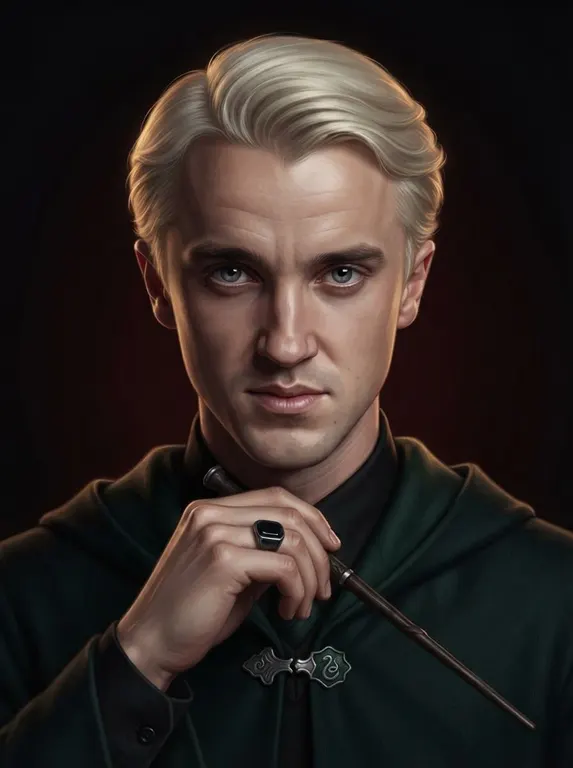
Slytherin heir · reformed but not redeemed
DracoMalfoy
The pure-blood heir of a disgraced house, all sharp edges and inherited guilt. Cold, proud, cutting — and quietly trying to become someone his family name never allowed. The rival everyone suspects, wants, or both.
Professional Quidditch chaser · fire of the family
GinnyWeasley
The youngest Weasley and the only girl — a fearless professional Quidditch player with a hex sharper than her brothers'. Bold, funny, refuses to be anyone's little sister or damsel; loves fiercely and dares openly.